"Dehaat" Business Study and Insight
DeHaat is one of India’s leading agritech startups, founded in 2012 by Shashank Kumar and Manish Kumar with a vision to transform the agriculture ecosystem. Headquartered in Gurugram, the company operates as an end-to-end platform that connects farmers with right advisory, financial and market linkages.
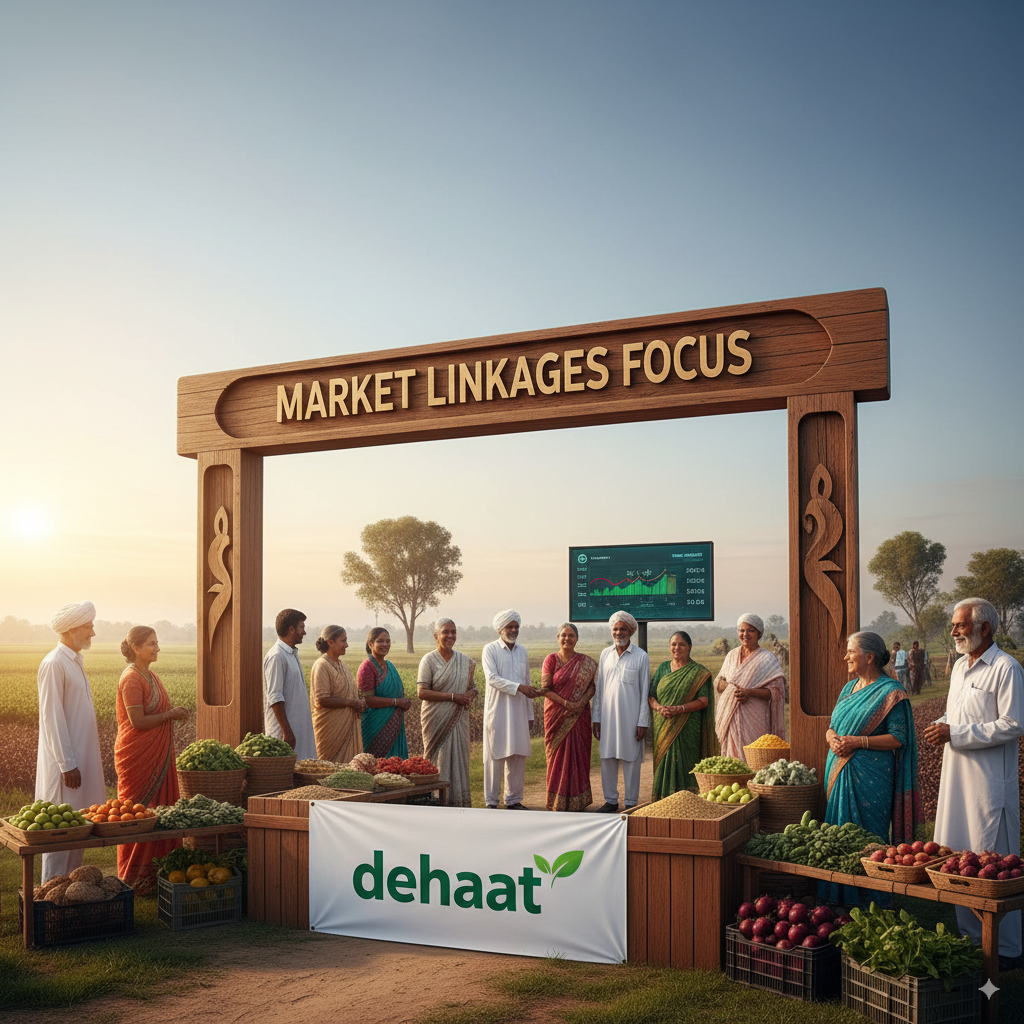
Market Linkages Focus
One of the core strengths of DeHaat lies in its ability to provide farmers with direct market linkages. Traditionally, small farmers were dependent on multiple layers of middlemen, which often resulted in low price realization for their produce. DeHaat built an integrated platform that connects farmers directly with institutional buyers, exporters, and organized retail, thereby ensuring better prices, timely payments, and reduced dependency on intermediaries.
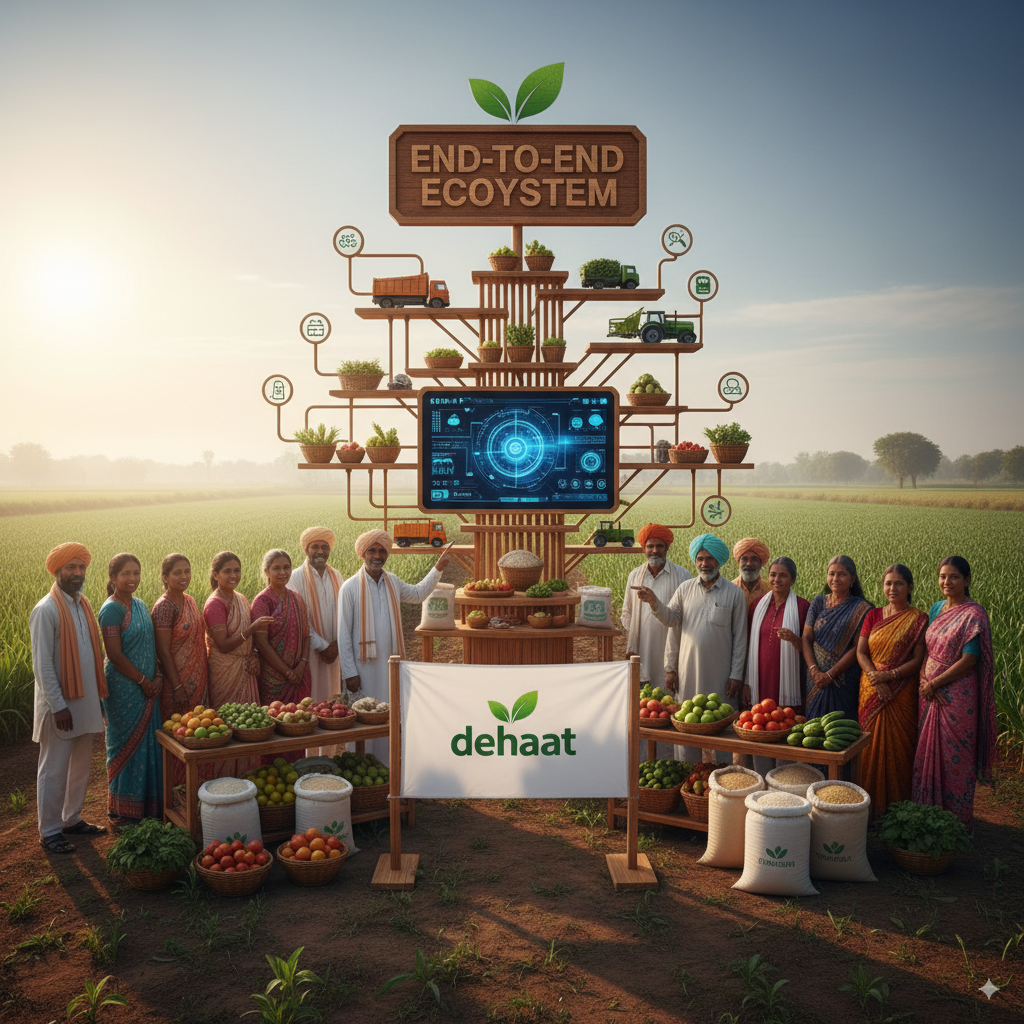
End to End Ecosystem
Beyond just supplying agricultural inputs, DeHaat has strategically positioned itself as a complete one-stop solution for farmers. The platform goes far beyond basic transactions by offering end-to-end services such as customized crop advisory based on soil health and weather conditions, scientific soil testing facilities, and financial support through partnerships with banks and NBFCs to provide easy access to credit and insurance. In addition, DeHaat manages efficient output procurement by connecting farmers directly with large institutional buyers, food processors, and exporters, ensuring fair pricing and timely payments. This holistic approach allows farmers to rely on a single ecosystem for all their agricultural needs, reducing inefficiencies caused by fragmented service providers.
Problem Statement
Indian agriculture, despite being the backbone of the economy, has long struggled with systemic inefficiencies and challenges. A majority of farmers are small or marginal landholders with limited access to quality seeds, fertilizers, and pesticides. They often rely on unorganized local vendors who may supply substandard products at high costs, directly affecting productivity and crop quality.
Another critical challenge lies in the lack of reliable crop advisory. Most farmers still depend on traditional knowledge or informal sources, which are often inaccurate and fail to address modern farming needs. Without scientific guidance on soil health, pest control, irrigation, or weather patterns, farmers face unpredictable yields and low productivity.
On the output side, farmers are heavily dependent on middlemen for selling their produce. This multilayered supply chain results in farmers receiving significantly lower prices, delayed payments, and no bargaining power. Coupled with limited access to credit and crop insurance, these problems trap farmers in a cycle of low income, high risk, and financial uncertainty.
DeHaat identified these pain points—fragmented services, lack of trustworthy information, and inefficient market access — As the core problems to solve in order to truly transform the Indian agricultural ecosystem.
Business Model
DeHaat operates on an integrated platform model that connects farmers with every service they need across the agricultural value chain. Its business model is designed to address the three most critical stages of farming — inputs, advisory, and market linkages — while creating revenue streams for sustainability.
Input Supply & Distribution
Farmers purchase seeds, fertilizers, and crop protection products directly through DeHaat.
DeHaat earns a margin or commission from agri-input companies for distributing their products to rural farmers.
Local “DeHaat Centers” act as physical hubs that ensure last-mile delivery and accessibility.
Advisory & Support Services
Through its AI-powered app, farmers receive personalized crop advisory, soil testing, and weather-based recommendations.
These services increase farmer trust and engagement, which indirectly boosts input sales and retention.
DeHaat does not charge farmers directly but leverages data-driven insights to build partnerships with agri-businesses and financial institutions.
Market Linkages (Output Sales)
DeHaat connects farmers with institutional buyers, retailers, and exporters.
It procures produce from farmers, aggregates it, and sells in bulk, earning margins on output sales.
This reduces farmer dependency on middlemen and ensures better pricing.
Financial Services & Partnerships
Collaborates with banks, NBFCs, and insurance companies to provide farmers with access to credit, loans, and crop insurance.
DeHaat earns referral fees and service charges through these partnerships.
Hybrid Approach (Digital + Physical)
Farmers interact via the mobile app in local languages, while DeHaat Centers provide on-ground support.
This hybrid structure allows for deeper penetration in rural markets and scalable growth.
Impact & Outcomes
DeHaat has built a strong presence across multiple states, serving over a million farmers and thousands of DeHaat Centers. Its model has improved access to quality inputs, reduced dependency on middlemen, and helped farmers secure better prices for their produce. Studies and reports highlight that farmers associated with DeHaat have seen higher yields and improved incomes, proving the effectiveness of its ecosystem-driven approach.
Challenges
Despite its rapid growth, DeHaat faces challenges in scaling across remote regions, where digital literacy and internet access remain limited. Maintaining efficient logistics in rural areas, managing seasonal demand fluctuations, and facing competition from other agritech startups like Ninjacart and AgroStar are additional hurdles. Building long-term trust with farmers, many of whom are risk-averse toward new technologies, continues to be a critical challenge.
Funding & Growth
Backed by global investors like Sequoia Capital, Sofina, and Omnivore, DeHaat has raised over $200 million to date. These funds have enabled rapid expansion, tech development, and strengthening of supply chains. With strong investor confidence and government focus on agri-digitalization, DeHaat is well-positioned to scale further, expand to new geographies, and solidify its position as one of India’s leading agritech platforms.
Future Outlook & Analyst’s Perspective
DeHaat has successfully demonstrated how technology and on-ground networks can work together to transform Indian agriculture. However, its long-term success will depend on continuously innovating around farmer engagement, building trust in rural communities, and optimizing its logistics to manage scale.
From a Business Analyst / Product Owner perspective, I see strong opportunities in:
Data-Driven Personalization: Leveraging farmer data to provide hyper-local crop recommendations, credit scoring, and predictive analytics.
Farmer Community Platforms: Building digital forums for knowledge sharing, peer learning, and collective bargaining power.
New Revenue Streams: Introducing subscription-based advisory packages or premium marketplace features for high-value crops.
Scalable Partnerships: Expanding collaborations with government schemes, banks, and agri-tech innovators to enhance reach and adoption.
In my view, DeHaat’s model is a blueprint for sustainable rural entrepreneurship. With the right product roadmap and data-backed decision-making, the platform can evolve into the largest farmer-centric ecosystem in India, while setting a global benchmark in agritech innovation.